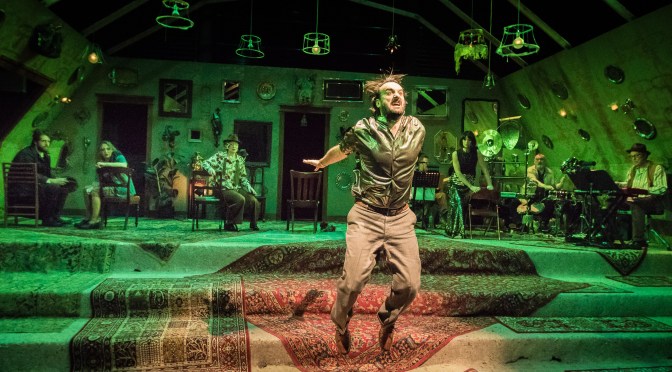
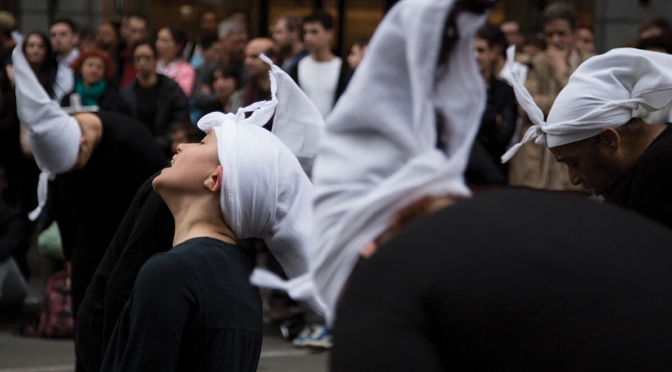
This past May, I went to Germany! I saw some theatre!
Here’s how it went down:

DIE LANGE NACHT DER NEUEN DRAMATIK 2018 // Münchner Kammerspiele
Four plays, one night, €15,000 in prizes: FALLEN by Anna Gschnitzer, BOOKPINK by Caren Jeß, DER DEUTSCHEN MUTTER by Frederik Müller, and LERCHELEIN by Danijel Szeredy! The colorful, much-lauded Art Nouveau building of the Münchner Kammerspiele always feels like this beautiful balance of homey and refined to me, a feeling that was magnified on this night by an auditorium full of warmth and excitement. Each play was presented in a staged reading; some were more elaborately outfitted than others (set pieces! music cues! live feed video!!!), but all were thoughtfully (and interestingly!) directed. My favorites of the evening were BOOKPINK, a playful examination of beauty and belonging starring a motley menagerie of birds, and LERCHELEIN, an adaptation of a Hungarian novel in which political unrest simmers underneath the everyday worries of a couple tending their newly emptied nest.

CREATION (PICTURES FOR DORIAN) // Gob Squad
The artists that make up the irresistibly playful Gob Squad are now all middle-aged, and while this show isn’t just about that, it’s the delightful, self-skewering in-road to what becomes a bigger meditation on things like how you choose (and don’t choose, actually) who you become, what it means to create connection, and what it means to spend a lifetime making art. Three core members of the Squad (as with all their pieces, they are always playing versions of themselves, and the casting line-up is fluid from night to night) are joined over the course of the piece by three young people just beginning a career in the arts and three elders within sight of the end of their career in the arts — a beautiful choice in casting that not only complicates Gob Squad’s questions in terms of age, but also brings a welcome panoply of other genders and ethnicities and lived experiences to the evening’s gentle explorations. It’s a bittersweet ode to the beauty in decay, to long lives lived well, to the idealism and confusion of youth, and, really, the idealism and confusion of just being a person trying to make things in the world.
Also unexpectedly fantastic was the surprise that this show is completely, seamlessly bilingual, performed in English and German for an audience who is assumed to understand both. Questions are posed in German and answered in English, and vice-versa. Performers speak their native languages and code-switch without pausing to translate. Nothing is unsatisfactorily paraphrased or otherwise flattened; every moment is allowed to live in its own lovely complexity. I left feeling refreshed, and also somehow more human than when I went in.

FRESQUE // Old Masters (Theatertreffen Stückemarkt 2018)
Every year in May, the ten “most noteworthy” productions from the German-speaking world are invited to the Berliner Theatertreffen: three glorious, whirlwind weeks of performances, workshops, panel discussions, the works in Berlin. The Stückemarkt is part of the Theatertreffen, but its focus is international and on works/texts of a generally smaller scale. Enter the two-person, multi-sculpture FRESQUE!
Performed in French with English supertitles by the Swiss collective Old Masters, FRESQUE is an experience suspended somewhere between installation and performance, and one that I found both kind of bewildering and kind of delightful. In what feels like a first act, two plaster-wigged characters muddle through a series of intentionally vague and emotionally mild encounters. Their relationships to each other and their environment(s?) cleverly evade any attempts to narrativize what’s happening before they cede ground to the imposing sculptural components of the piece. Despite the sudden lack of human characters, this second part is the most “dramatic.” Sound escalates into a seat-rattling roar; lighting that started out inoffensively functional becomes kinetic and dangerous. Time clearly passes, at speed, and maybe space does too, and as the lights come up we have somehow been marooned somewhere entirely different than where we started — all with only minimal changes to what’s visible and invisible in the picture above. Like I said before: bewildering, and delightful.

FAUST // Frank Castorf (Theatertreffen 2018)
Director Frank Castorf is his own genre — and his trilingual, multi-textual FAUST is seven-hours-minus-twenty-minute-dinner-break of unadulterated that. I was basically delirious by the end, I definitely fell asleep at one point, it was glorious and occasionally offensive and truly weird and also incredible?
I don’t think he’s at all interested in individual plays except for whatever kernel of inspiration he’s selected as the springboard that’ll get him to what he actually is interested in talking about. There is so much going on over the course of the thing that a plot summary (or even just a coherent list of sequential events, plot be damned!) is both impossible and irrelevant, but here’s at least some of what I got out of the madness:
- There are some characters who recognizably belong to FAUST for at least some of the time
- an entire Émile Zola play inserted in the second half just because
- interjections of first-hand accounts of Algeria’s fight for independence from France
- musicians that show up to sing songs that are fantastic but don’t appear to have any clear connection to whatever happens to be happening at the moment
- the three-story labyrinth of a set piece revolving to reveal a multitude of hidden worlds in its many, many, many corners, including an entire 19th century Paris metro carriage with a full-on greenscreened cityscape flying past its windows
- multiple camera crews chasing the action onstage for the vast majority of the performance, as it’s often otherwise completely obscured by aforementioned utterly massive set piece
- somewhere a true hero of a video editor is editing those feeds live (!), turning them into what feels like a single camera TV drama, projected onto giant billboards
- supertitles in English, supertitles in French, supertitles actually at one point chastising an actor for relying on them instead of having memorized his lines (scripted?? unscripted?? we’re maybe three hours in and not even halfway through, it’s hilarious, who cares!)
- an unbelievably hardcore cast of actors who were going just as hard at midnight as they had been at 6pm.
- (Bonus: the fourth wall doesn’t exist, it never existed!)
Castorf directs like he’s curating a multimedia installation of loosely interconnected works, but his materials happen to be humans and time and live video and towering set pieces that defy every conventional idea about dramaturgy and narrative cohesion. Despite theatre’s inherent collaborative nature, his works are so clearly specifically his, and he is doing so many things at once, all the time. I don’t know that he needs seven hours to do that, but he wants seven hours, so, why not? Why not throw everything together in a mess of associations and historical ephemera, and let the audience pull what they want from the pile?
Honestly, though, any intended or implied snark aside, I do admire Castorf’s ambition and the precision with which every last bit of chaos is executed (bless you, undoubtedly extensive stage management team, bless you). Exeunt’s Lee Anderson called Castorf’s approach “liberating and infuriating in equal measure” in his hour-by-hour recap/review of FAUST, and I completely agree. Some of it’s brilliant and illuminating! Some of it’s obnoxious and tiresome! A lot of it’s loud! But there is something truly wonderful about how batshit crazy it is — how exhilarating it is to be caught up in something that is so awe-inspiringly huge and that creates the conditions for almost literally anything to happen onstage. It’s thrilling to experience an evening where the rules of engagement are not only suspended, but fully and completely obliterated. Even with the aid of supertitles, I still don’t really know what it was about, or what Castorf wanted me to take away, but I’m also pretty sure that’s not the point. It was a singular evening spent in an entirely different theatrical universe, and I’m so glad to have been entertained and exhausted by its singular insanity.
top picture via the Berliner Festspiele